Bloxorz
Games You May Like
Think Before Every Roll in Bloxorz
Bloxorz is a spatial puzzle game that looks simple on the surface but reveals remarkable depth with every level. Your only job is to roll a rectangular block across a suspended grid of tiles and drop it standing upright into a square hole at the end. That setup sounds manageable — until the platform starts narrowing, bridges activate on pressure switches, and one careless roll sends your block tumbling into the abyss for the hundredth time.
What makes Bloxorz so compelling is the physical logic baked into every challenge. The block behaves exactly like a real rectangular object would — it rolls differently depending on which face it stands on, covers two tiles when flat, and requires precise upright positioning to fall correctly into the goal. Players who approach it like a pure geometry problem find it clicks much faster than those who try to feel their way through.
Understanding How the Block Moves
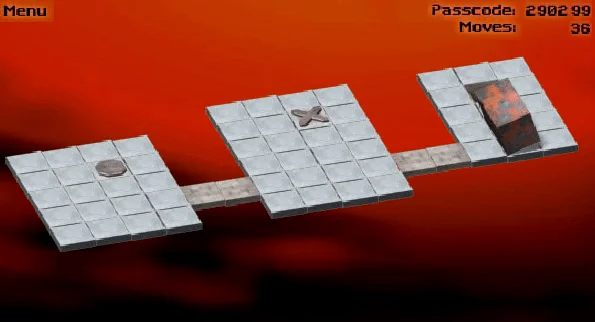
The block has two orientations that completely change how it interacts with the puzzle:
- 📐 Standing upright: Only occupies a single tile. This is the only orientation that can fall into the goal hole. Heavy switches require this orientation to activate.
- 📏 Lying flat: Spans two tiles, either horizontally or vertically. More stable on wider platforms but cannot enter the hole, and some fragile tiles will crack under the double weight.
Always be aware of which orientation you are in before moving. A poorly timed flat roll across a fragile tile is the most common way to lose progress in mid-game levels.
Key Mechanics That Change the Puzzle
As levels progress, Bloxorz introduces mechanics that add layers to the core rolling challenge:
- 🔘 Soft switches: Activate when the block touches them in any orientation — they trigger bridges, open tiles, or rearrange the platform layout.
- ⬛ Heavy switches: Only activate when the block stands perfectly upright on top of them. Flat contact does nothing, so positioning matters enormously.
- ⚠️ Fragile tiles: Crack under the block when it lies flat but hold when it stands upright. Planning your path to avoid flat contact on these tiles is one of the game's main spatial challenges.
- ✂️ Split teleporters: Some levels feature teleporters that split the block into two separate pieces, which you then control independently and must reassemble into a single block before reaching the goal.
How to Approach Each Level Strategically
Bloxorz rewards deliberate thinking over trial and error. Players who pause to plan a route before touching anything consistently solve levels in fewer attempts:
- 🗺️ Scan the full layout first: Before making your first move, identify where the goal hole is, where the fragile tiles are, and where any switches sit.
- 📍 Count available tiles: On narrower levels, route planning often comes down to which path through the platform actually has enough tiles to reach the goal without dead-ending.
- 🔄 Plan switch activation order: Some bridges only activate temporarily. Think about when to trigger them relative to your current position — activating too early can leave you stranded when the bridge closes again.
- ⚖️ Watch your orientation constantly: Every move changes whether you are flat or upright. Building a mental model of your orientation before each keypress is the single most impactful skill in Bloxorz.
- ↩️ Use restart liberally: Unlike games where restarts feel like failure, in Bloxorz they are just part of the thinking process. Going back to test a different approach is faster than struggling through a dead end.
Why Bloxorz Still Holds Up After All These Years
Bloxorz was created by Damien Clarke in 2007 and became one of the defining browser puzzle games of its era. What kept it relevant long after its initial release is its design purity: every mechanic serves the core concept, nothing is padded, and each level genuinely teaches a new spatial relationship without ever having to explain it with text. You understand a fragile tile by falling through one. You understand a heavy switch by failing to activate it with a flat block. The game teaches through consequence rather than instruction, which is a design philosophy that ages extremely well.
Tips to Solve Harder Levels Faster
- 🧠 Always check your block's orientation before triggering a switch — heavy switches require upright contact and a common mistake is pressing one while flat.
- 🚫 Avoid rolling flat over orange fragile tiles; route around them using longer paths if necessary — the extra moves are far better than restarting.
- 🎯 On split-block sections, plan how to rejoin the pieces before you move either one — it is easy to maneuver yourself into an unrecoverable position.
- 📝 For the hardest levels, sketch the layout on paper. Bloxorz rewards spatial reasoning and having a visual reference dramatically speeds up route-finding.
- 🔁 If you are stuck on a level for more than ten attempts, restart and try the opposite direction — many levels have a non-obvious approach from the other side of the board.
Why Bloxorz Is Still a Great Brain Warm-Up Game
Few puzzle games teach clean spatial thinking as efficiently as Bloxorz. Each stage is compact, but every tile matters, so your brain stays fully engaged without requiring long sessions. That makes it perfect for short play windows while still delivering the satisfaction of solving genuinely hard logic problems.
If you enjoy puzzles that reward patience, route mapping, and careful execution, Bloxorz remains one of the strongest classic browser experiences to revisit.
Hot Games

New Games

