Flip Master
Games You May Like
Flip Master: One Button, One Trampoline, One Perfect Landing
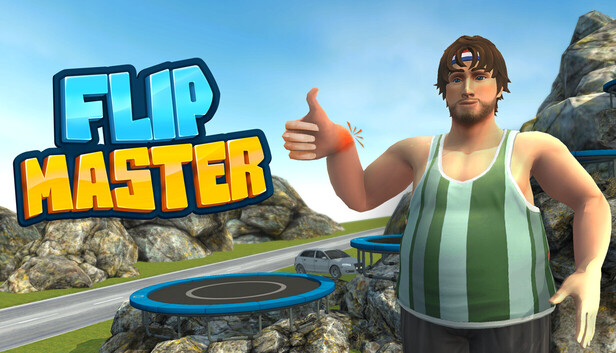
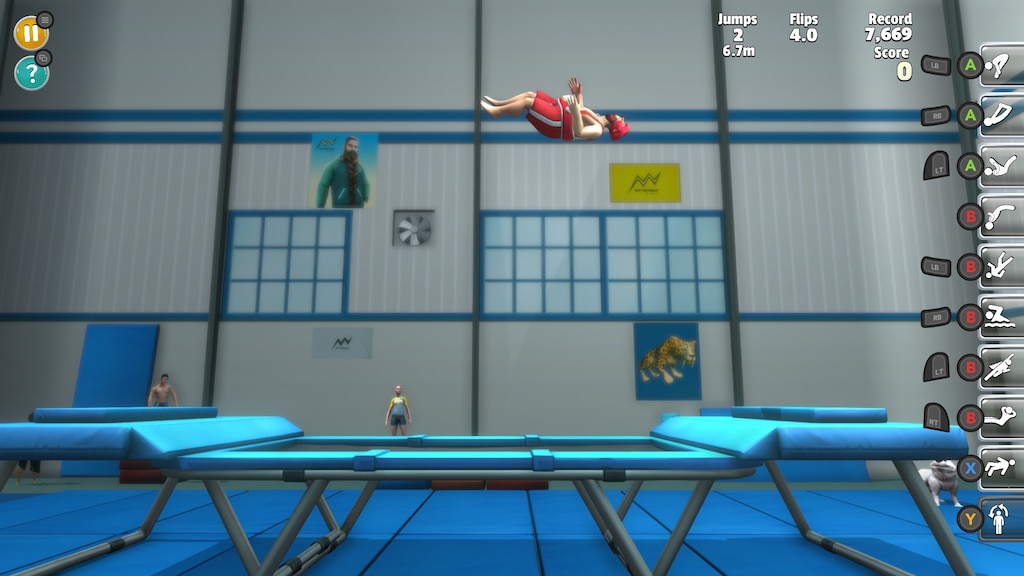
Flip Master is a ragdoll trampoline game built around a single, deceptively hard question: can you stop spinning in time? You drop onto the mat, hold to squash the bed and load your jump, launch, hold again to pull your athlete into a tuck — and then let go at exactly the right instant so your feet, not your face, meet the canvas. Hold a heartbeat too long and the whole body folds over and crumples in a heap.
What makes it stick is that nothing is animated on rails. MotionVolt Games built Flip Master on a custom physics engine with fully simulated ragdoll athletes, so every rotation, every clipped heel, every knee-first faceplant and every clean landing is worked out live. Two runs that look identical can end completely differently because you released a few frames apart.
Controls and Basic Gameplay
- 🖱️ Hold to charge: Hold the left mouse button (or tap and hold on touch) as you fall toward the mat to compress the bed and store energy for a bigger jump.
- 🚀 Release to launch: Let go at the bottom of the compression — the deeper the bed and the better the timing, the higher you go and the more rotations you can fit in.
- 🔄 Hold again in the air: Holding mid-flight pulls your athlete into a tuck and starts the rotation spinning.
- 🧍 Release to lay out: Let go to open the body back up, kill the spin, and line your feet up with the mat.
- ⌨️ Keyboard: Spacebar handles jumping and flipping, and A/D or the Arrow keys let you nudge the direction of the rotation.
That is the entire control scheme: one input, held for the right length of time, twice per jump. Everything else — how many rotations you squeeze in, whether you land on your feet, your back or your head — falls out of the physics. It takes ten seconds to understand and a very long time to actually be good at.
Thirteen Tricks, From Your First Backflip to a Full Layout
You start with nothing but a plain backflip. Coins from clean landings unlock the rest of the book: frontflips, gainers (a backflip thrown while still travelling forward, so you have to spot a landing that is moving away from you), layouts (a flip with the body held straight instead of tucked — it rotates far slower, scores far more, and punishes a lazy release brutally), plus more than ten further tricks and variations.
Scoring rewards commitment. A single tidy backflip banks a modest amount; the same jump turned into a double, or into a layout, or into a gainer thrown off the edge of the bed, multiplies it. Land clean and the run keeps going and the multiplier keeps climbing. Crash once and the count starts again from zero, which is exactly why good players bail out to a safe single flip when their height is wrong instead of forcing the double.
More Than 35 Arenas, Each With Its Own Bounce
Every location changes the physics under your feet, so a trick you own on one bed has to be relearned on the next:
- 🏡 Backyard: A saggy garden trampoline with soft, shallow bounce. Low ceiling, low stakes — where you learn to feel the compression.
- 🏋️ Gym: Proper sprung equipment with real height, plus walls and apparatus to keep you honest about staying centred.
- 🏅 Competitive: A tournament bed that throws you enormous air. Suddenly there is room for triples — and much further to fall.
- 🎪 Crazy Circus: Big top chaos, with the kind of stage dressing that turns a missed landing into a proper spectacle.
- 🤸 Trampoline Park: A floor of connected mats, so a run becomes a journey — bounce from bed to bed and keep the combo alive across the whole park.
- 🌊 Underwater: One of the newest additions, where everything slows to a dreamy crawl and your timing windows stretch out into something completely different.
- 🌲 Forest: Open-air bouncing among the trees, with fresh scenery and its own bounce profile to read.
Characters and Power-Ups
Characters here are not skins. Each one carries its own physics, so weight and build genuinely change how hard you hit the mat, how fast you rotate in a tuck, and how much air a full-power bounce buys you. You unlock, upgrade and customise them as you earn coins — the roster runs from everyday jumpers to oddities like the Classic Diver in a vintage brass-helmet deep-sea suit, alongside the streamer characters added in later updates.
- 🏐 Medicine Ball: Brings extra weight into the run to get the bounce going hard from the very first jump.
- 🧊 Foam Cube: Turns the session into a foam-pit party and changes the way your landings behave.
- 🪙 Coin Rain: Showers the arena with coins for a straight gold rush — the fastest way to fund your next trick unlock.
Daily Challenges, Leaderboards and Replays
Beyond free jumping there are daily challenges across three difficulty tiers, so there is always a fresh target — land a set number of gainers, survive a combo streak, hit a score on a specific bed. Results feed into leaderboards and achievements, and the built-in recorder saves your run so you can send the one perfect triple layout, or the truly catastrophic crash, to a friend.
Key Features That Make It Addictive
- 🤸 Real Ragdoll Physics: A custom engine simulating every limb, so no two landings are the same.
- 🌀 13+ Unlockable Tricks: Backflips, frontflips, gainers, layouts, bounces and more, each with its own timing window.
- 🗺️ 35+ Arenas: Backyard, gym, competitive, circus, trampoline park, forest and underwater, all with distinct bounce.
- 🤹 Characters With Unique Physics: Unlock, upgrade and customise jumpers who genuinely feel different in the air.
- ⚡ Power-Ups: Medicine Ball, Foam Cube and Coin Rain to reshape a run before you even start bouncing.
- 🏆 Daily Challenges & Leaderboards: Three difficulty tiers, achievements, and replay recording for your best runs.
Tips for Mastering Flip Master
Start with the bounce, not the trick. Before you attempt anything fancy, spend a run just charging and releasing until you can consistently reach maximum height — height is what buys you rotation time, and no amount of good tucking rescues a weak jump.
Then learn to stop early rather than late. Beginners almost always over-rotate, because holding the tuck feels safe and releasing feels like giving up on the trick. It is the opposite: let go a touch sooner than feels right, let the layout carry you the rest of the way round, and you will stick landings you were previously smearing across the mat. Watch your athlete’s shoulders rather than the feet — shoulders coming level with the horizon is your cue to open up.
Finally, protect the combo. When a launch comes up short or you drift toward the edge of the bed, bail to a single flip and take the small score. A run of twelve clean singles beats one heroic triple followed by a faceplant, and in the trampoline park you can keep that streak rolling from mat to mat as long as you stay patient.
Hot Games

New Games

