Getting Over It with Bennett Foddy
Games You May Like
Getting Over It with Bennett Foddy: A Man, a Cauldron, and a Hammer
Getting Over It with Bennett Foddy gives you a bare-chested man wedged waist-deep in a black iron cauldron, a long-handled Yosemite hammer, and a mountain of garbage to climb. He is called Diogenes, after the ancient philosopher who famously lived in a pot, and he cannot walk, jump, or crawl. The only thing he can do is swing that hammer — hook it behind a ledge and haul, plant the head on a rock and vault, or wind up and catapult himself into the sky.
Then there is the part that made this game infamous: there are no checkpoints. None. Not one. Every metre you gain is held only by your grip on the hammer, and a single sloppy swing near the top can send Diogenes tumbling, bouncing and sliding all the way back to the tree stump you started at. Hours of work, gone in about eleven seconds, while Bennett Foddy calmly narrates a passage about disappointment over the top of it.
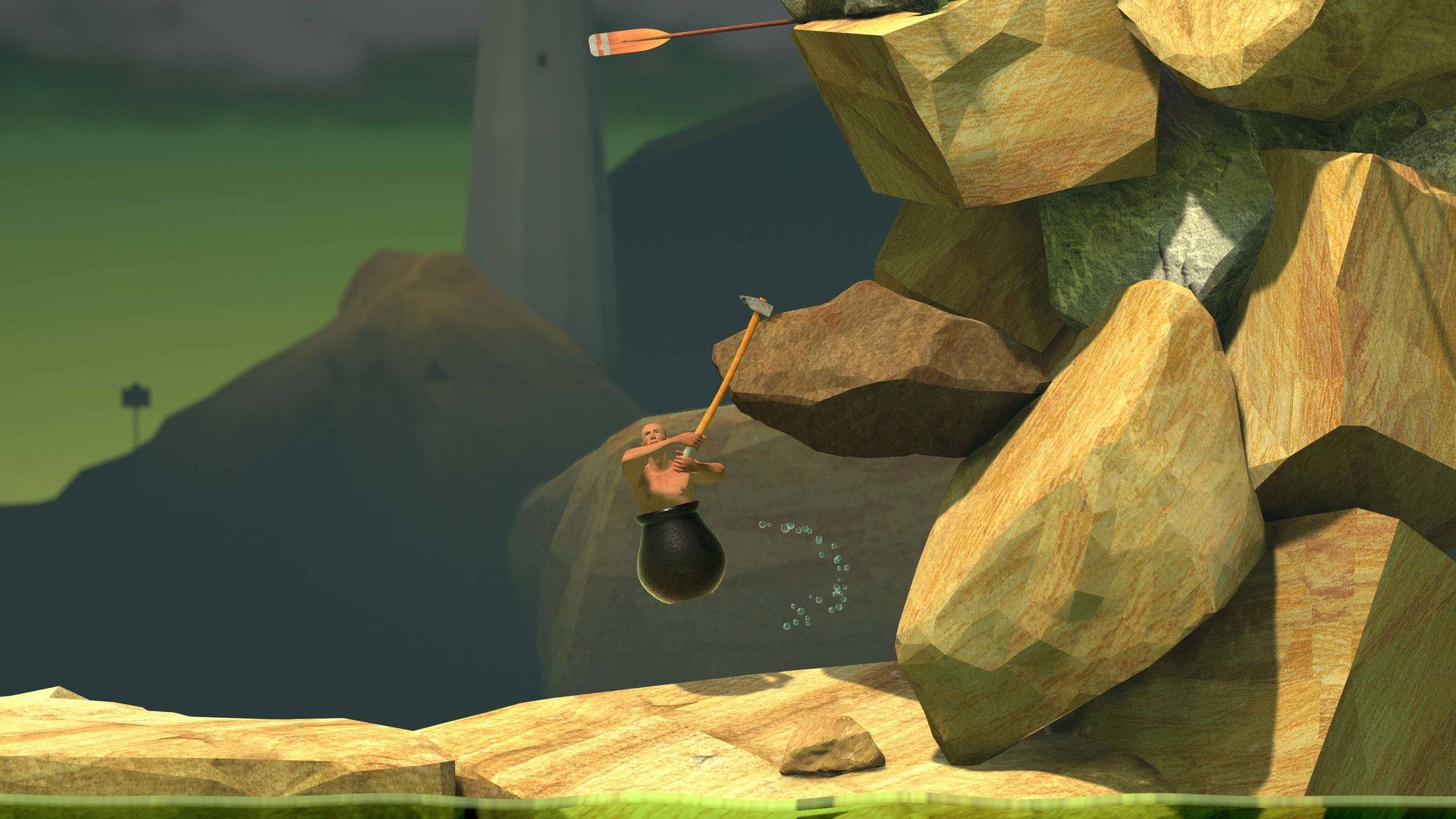
Controls: There Is Only the Mouse
- 🖱️ Move the mouse: The hammer follows your cursor exactly. That is the whole control scheme — no keys, no buttons, no jump.
- 🪝 Hook and haul: Catch the hammer head on the far side of a ledge and drag the cursor back toward yourself to pull the pot up over the lip.
- 🎯 Plant and vault: Press the tip into the ground and sweep the mouse in an arc to rotate your whole body over the pivot — the move that clears most gaps.
- 🚀 Wind up and launch: A fast, wide swing throws Diogenes properly airborne. It is the fastest way up, and the fastest way down.
- 🖥️ Mouse or trackpad: Both work, but a real mouse with a steady, unchanging sensitivity is worth a lot here. Your progress is muscle memory, and changing DPI mid-climb throws all of it away.
Nothing about the input is hidden or complicated. The difficulty is entirely in the physics: the hammer has weight, the pot has momentum, and the game never smooths over a bad decision.
The Mountain: A Surrealist Pile of Digital Junk
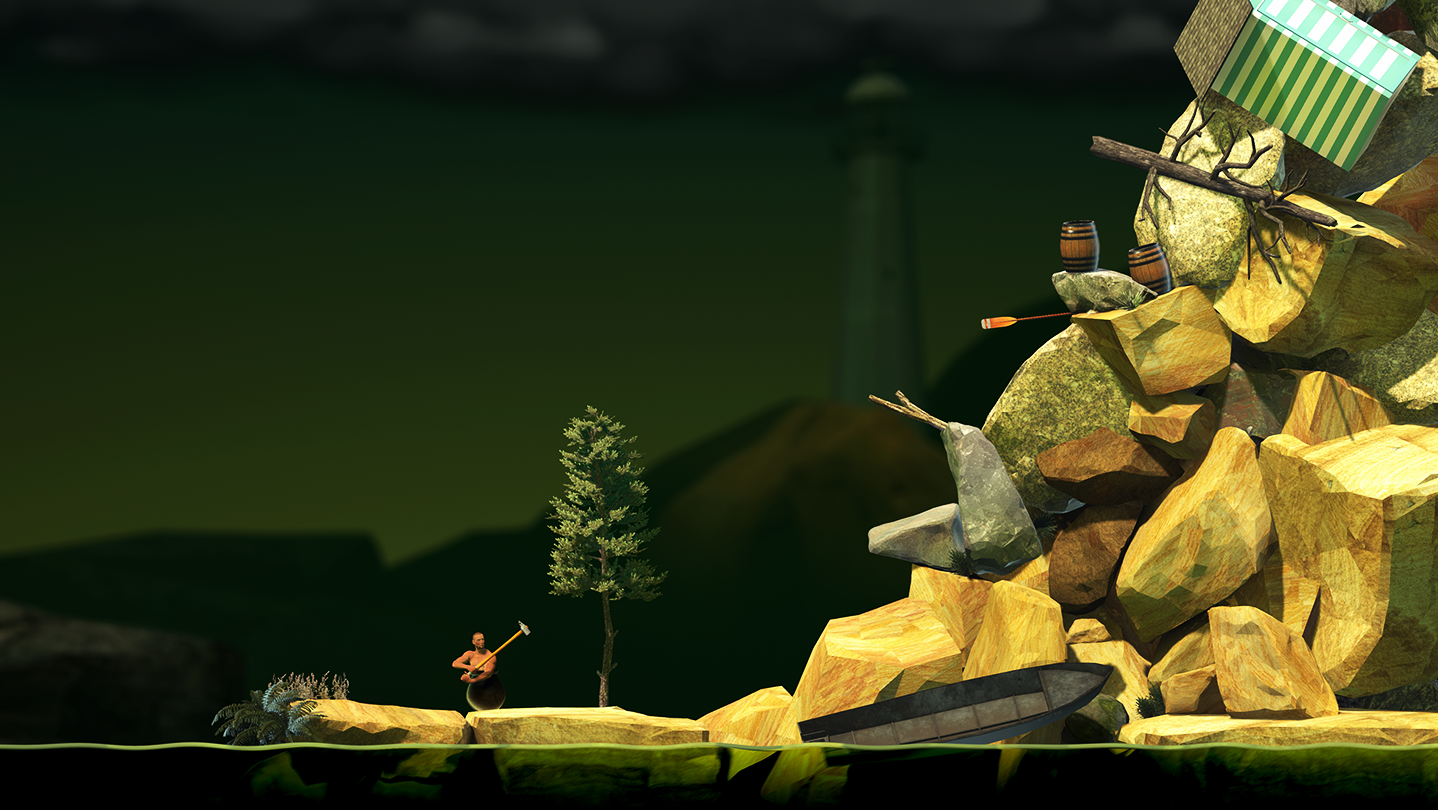
The climb is not a landscape so much as a landfill. Boulders and trees give way to abandoned playground equipment, stacked furniture, industrial pipes and assorted debris — discarded assets bolted together into a tower. Every obstacle has been named by the community, and every one of them has ended somebody’s run:
- 🌳 The Tree and the Tutorial Hill: The gentle opening, where you learn to hook and haul. You will see it again. You will see it many times.
- 🕳️ Devil’s Chimney: An early vertical shaft that acts as the game’s real skill gate — you climb it by bracing the hammer against both walls, and plenty of players quit here.
- 🍊 Orange Hell: A cliff crowned by a single orange tree, with an approach so awkward it has its own reputation for eating attempts.
- 🪑 The Furniture and the Playground: Chairs, tables, slides and swings stacked into a climbing wall that gives you almost nothing solid to push against.
- ⛪ The Church Roof: Steep, smooth and near impossible to grip — one panicked swing and you skate straight off the tiles.
- 🐍 The Snake: The single most feared object in the game. Touch it and it funnels you almost the whole way back to the start, with no way to stop yourself.
- 🪣 The Bucket: A swinging obstacle that has to be timed rather than muscled through.
- 🧊 The Ice: Slick slopes near the summit, where the hammer skids and momentum you cannot cancel becomes the enemy.
- 📡 The Cable Tower: The last obstacle. Get on top of it, throw yourself upward, and you leave the mountain entirely.
Bennett Foddy Talking in Your Ear
Foddy narrates the entire climb himself. He explains why he built the mountain from recycled junk, muses on the culture of digital detritus, and reads out quotations about failure whenever you lose serious ground. The tone is calm, warm, and quietly infuriating — he is not mocking you, which somehow makes losing forty minutes of progress worse. It is one of the very few games where the voice-over is genuinely part of the difficulty, and part of why players kept recording their reactions.
Where It Came From, and What It Started
Getting Over It is an open homage to Sexy Hiking, a rough 2002 freeware game by the Czech designer Jazzuo that had circulated for years as a private joke among indie developers. Foddy, who teaches game design at NYU, decided its design was worth taking seriously and rebuilt the idea properly. He released it through Humble Monthly on 6 October 2017 and on Steam that December, where it reached well over 2.7 million players, became a streaming phenomenon, and won the Nuovo Award at the 2018 Independent Games Festival.
It also created a genre. Games built on the same cruel bargain — hard controls, no checkpoints, catastrophic falls — are now called Foddian, and the line runs directly from here to Jump King and Only Up!
Reaching Space, and the Reward Nobody Talks About
The mountain does end. Past the ice and up the cable tower, one good launch carries Diogenes off the top of the map and into space, where you bounce off drifting asteroids and float upward as the credits roll. Then the game asks you a question: are you recording this? Answer no, and you are let into a chatroom shared only by other people who have actually finished — a small, strange, permanently private room that no walkthrough can hand you. Speedrunners have since reduced the whole climb to a couple of minutes. Most players who finish it take several hours, and most players never finish it at all.
Key Features
- 🔨 One-Input Physics: The mouse controls the hammer and nothing else — instantly understandable, brutally hard to master.
- 🚫 No Checkpoints: No saves to fall back on, no safety nets, no forgiveness for a bad swing.
- 🗿 A Mountain of Junk: A surrealist collage of rocks, furniture, playground equipment and industrial debris to haul yourself over.
- 🎤 Full Narration by Bennett Foddy: Philosophy, design commentary and consolation prizes delivered live as you fall.
- 🐍 Legendary Obstacles: Devil’s Chimney, Orange Hell, the Church roof, the Ice and the Snake.
- 🌌 A Real Ending: Space, credits, and a finishers-only chatroom you can only earn.
Tips for Actually Getting Over It
Go slow. Almost every catastrophic fall starts with a fast, panicked swing. Small, deliberate mouse movements keep the hammer where you can see it; big flails send the pot spinning with momentum you have no way to cancel. The players who finish are not faster than you, they are calmer.
Learn the hook before anything else. Most of the mountain is climbed by placing the hammer head behind an edge and pulling gently toward yourself, not by launching. Save the big wind-up swings for gaps that genuinely cannot be crossed any other way, and always ask what happens if this one misses — if the answer is the Snake, do it the slow way.
Treat falls as practice, not punishment. Sliding back to the tutorial hill means you get to run the early section again, and that repetition is exactly how Devil’s Chimney stops being frightening. Rather than restarting instantly in a rage, sit still for a moment, work out which swing actually killed you, then climb back up deliberately. And when you are tilted, stop — nobody has ever cleared the ice while furious.
Hot Games

New Games

