Gun Spin
Games You May Like
Gun Spin Turns Recoil Into Movement and Makes Every Shot a Travel Decision
Gun Spin looks tiny at first glance, but its loop is clever: your bullets are not just for scoring, they are the force that propels your gun forward. Fire timing, angle control, and ammo economy combine into a physics distance challenge where one wasted burst can stall momentum completely.
Each attempt becomes a planning puzzle. Do you spend bullets early for acceleration, or save them for recovery when rotation gets awkward? That constant trade-off is what keeps the game engaging across repeated runs.
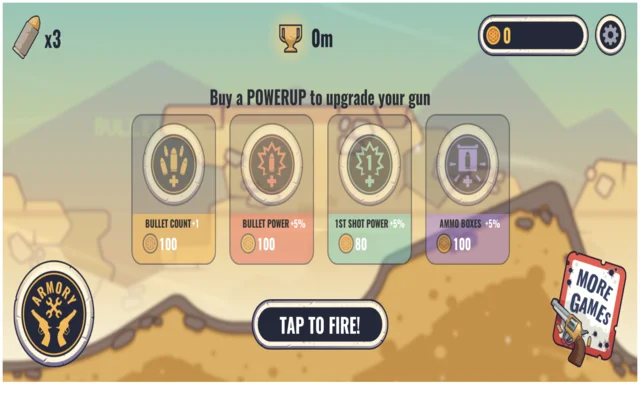
How to Travel Farther Consistently
Distance in Gun Spin comes from smooth momentum management, not panic tapping. Controlled burst timing keeps your trajectory stable, while upgrade choices determine whether your run has enough ammo and force to survive difficult rotation phases.
- Use short, timed bursts instead of emptying magazines in one panic sequence.
- Fire during favorable orientation windows to avoid recoil canceling your travel.
- Upgrade ammo capacity early when runs fail from premature dry-out.
- Prioritize force upgrades after stability improves, then stack distance gains.
- Treat bad angles as reset points and rebuild momentum deliberately.
Gun Spin succeeds because it transforms a simple mechanic into meaningful mastery. Every run teaches better timing, better angle judgment, and better upgrade sequencing, which makes progression feel skill-based instead of random.
Advanced Consistency Notes for Gun Spin
Once your basic runs are stable, the next jump in performance usually comes from cleaner decision sequencing. Instead of reacting to each moment independently, treat the run as a chain where each choice sets up the next one.
Players who improve fastest in Gun Spin review repeat failure patterns and fix one category at a time. This method compounds quickly because fewer repeated mistakes means more quality attempts per session.
- Start each session with one low-risk warm-up run to rebuild timing rhythm.
- Track which situations fail most often and isolate them in focused retries.
- Prefer repeatable setups over flashy high-variance plays when building consistency.
- Take short resets after mistakes so frustration does not distort decision quality.
- When performance drops, slow down and re-center on core fundamentals first.
- Use small adjustments between attempts rather than changing your whole approach.
- Review successful runs to identify what should become your default pattern.
Replay Value and Skill Growth
Gun Spin remains rewarding over time because progress is measurable. Better routing, sharper timing, and cleaner execution translate directly into more reliable outcomes.
That feedback loop keeps sessions engaging: each run teaches something concrete, and each correction makes the next attempt meaningfully stronger.
Hot Games

New Games

