Hammer 2: Reloaded
Games You May Like
Hammer 2: Reloaded — An Open City, Thirty Jobs, and No Arrest Warrants
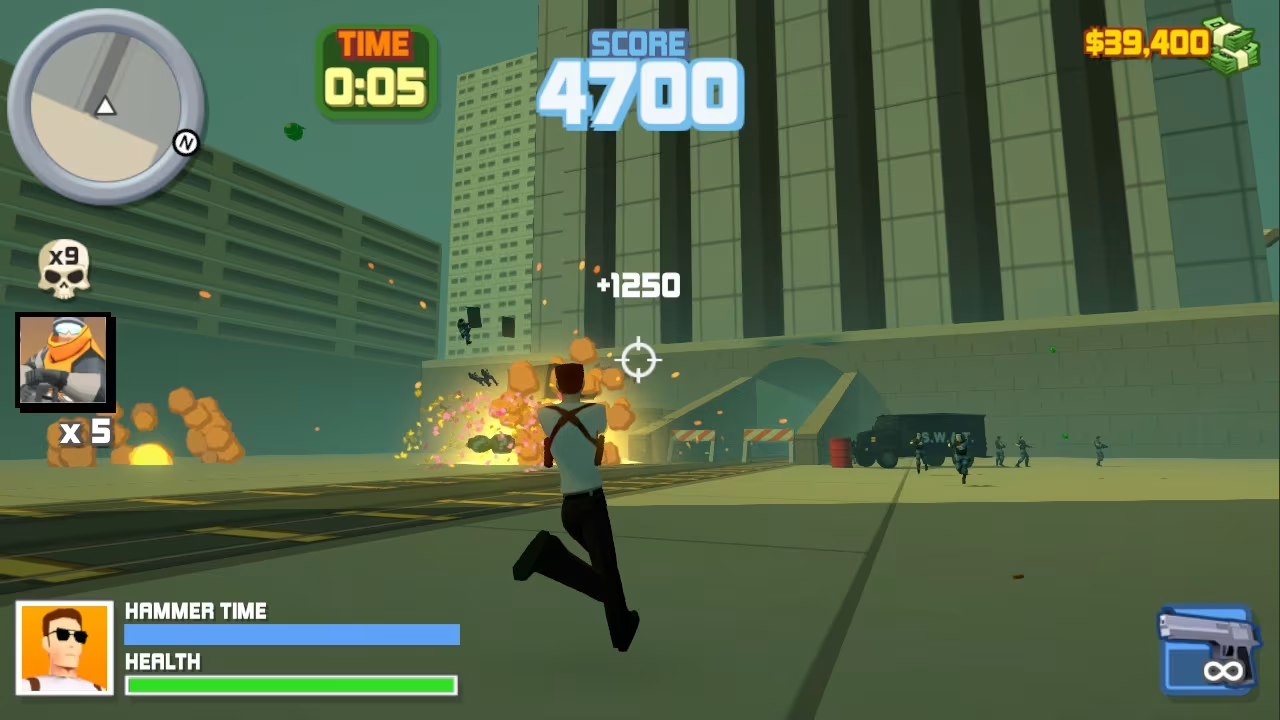
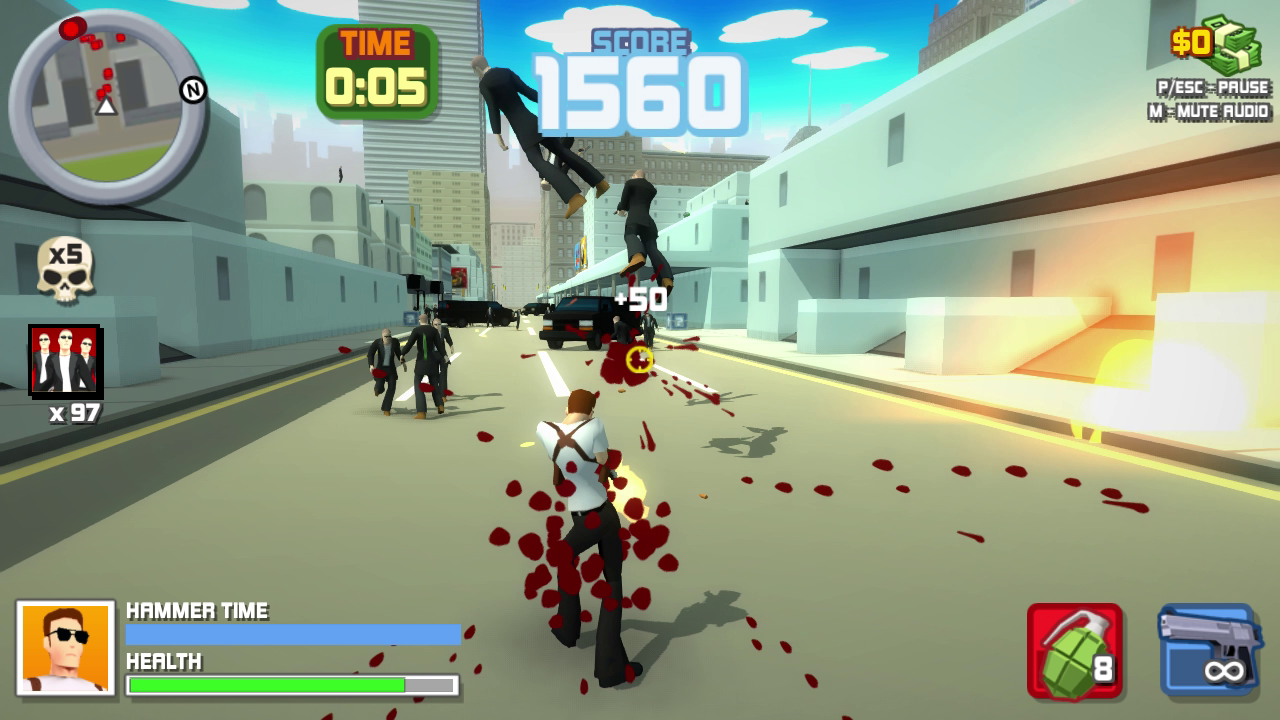
Hammer 2: Reloaded hands you a city that has comprehensively lost control of its crime problem, and then hands you the solution: a vigilante who does not read anybody their rights. There is no arrest mechanic, no non-lethal option, no morality meter. Criminals are a problem, and you are the thing that removes problems.
It is the expanded version of Hammer 2, built by Faramel Games and released in March 2019, with its last content pass in June 2022. It has since collected close to 580,000 player ratings at a 4.5 average — the kind of number that only happens when a browser game gets played for years rather than weeks.
One important practical note before you start: this one is desktop only. It wants a keyboard and a mouse, and unlike most games on this site there is no touch fallback.
Controls
- ⌨️ WASD or Arrow keys — move on foot, and drive when you are in a vehicle.
- ⬆️ Space — jump. Also how you get onto things you were probably not meant to be on.
- 🔫 Left Click or Z — shoot.
- 💣 X — throw a grenade.
- 🔍 C — zoom the camera in. Genuinely useful — pulling in tight is how you land shots at range instead of spraying.
Thirty Missions, One City
The structure is not a level select — it is a single continuous city with thirty missions laid across it. You take a job, you drive or walk to where it is happening, and you deal with it. Objectives change the shape of each one: clearing out a group holed up somewhere, hitting a target, surviving contact with a much larger force than you should be able to handle.
Because the city stays open between jobs, the mission list doubles as a tour of the map. By mission fifteen you know which routes are fast, where the useful rooftops are, and which junctions turn into a shooting gallery every time you drive through them. That accumulated local knowledge is the closest thing the game has to a progression system on foot.
Cars, Tanks, and the Vehicle Generator
You are never restricted to your feet. Cars parked around the city can be taken and driven, which is the sane way to cross the map — and then there are the tanks. Hijacking a piece of heavy armour genuinely changes the game: a mission that was a careful cover-to-cover firefight becomes you driving a cannon down the middle of the street. The game clearly knows this and leans into it rather than balancing it away.
The best quality-of-life item in the whole game, though, is the vehicle generator: an upgrade that lets you make a car appear wherever you are standing. No hunting for a parked vehicle, no long walk back after a mission goes sideways in the wrong district. It sounds like a small convenience and it changes the pace of the entire game.
The Shop Will Sell You Invincibility
Mission cash goes into upgrades, and the list is unusually bold about what it is willing to hand over:
- 🚀 Jet pack — vertical freedom. Rooftops stop being scenery and become the map, and a lot of missions have a much easier answer from above.
- 💣 Unlimited grenades — removes the only real ammo constraint on your best crowd-clearing tool.
- 🚗 Vehicle generator — spawn a car anywhere, any time.
- 🛡️ God mode — yes, actual invulnerability, bought with in-game money.
That last one deserves an honest word rather than a wink. Selling God mode is a deliberate design decision, and it splits the game cleanly in two. The first half is a real third-person shooter where cover matters and a bad approach gets you killed. The second half, once you are rich, is a sandbox: jet pack on, grenades infinite, damage irrelevant, and the city becomes a toy rather than a threat.
Neither half is wrong, but the order matters. Buy God mode early and you skip straight past the part of the game that was actually testing you. Most players get far more out of it by saving invincibility until the missions have stopped surprising them.
Where It Comes From
Faramel Games have a very recognisable house style, and Hammer 2 sits right in the middle of it. Their catalogue is full of browser-sized 3D open-city playgrounds — Cars Thief, Cars Thief: Tank Edition, City Rider, Gangster Contract Mafia Wars, 3D Car Simulator, 3D Moto Simulator 2 — all built on the same instinct: give the player a city, give them vehicles, do not fence anything off, and see what happens.
Hammer 2: Reloaded is what that instinct looks like when you point it at a shooter instead of a driving game. The driving DNA is still visible in how the city is built and in how casually it lets you steal a tank.
Tips for Clearing the City
- Use C constantly. Zooming in is the difference between hitting things and generating noise. Most new players never touch it and wonder why enemies at distance feel unkillable.
- Buy the vehicle generator first. Not the flashiest purchase, but it saves you more time across thirty missions than anything else on the list, and time is cash.
- Grenades before doorways. X costs nothing once you have the unlimited upgrade, and rooms full of enemies are far cheaper to open with an explosion than with your face.
- Steal a tank when a mission looks impossible. If a job is throwing more bodies at you than you can handle on foot, that is usually the game hinting you should be arriving in armour.
- Do not rush God mode. It is the most expensive thing in the shop and also the fastest way to end the game as a game. Enjoy the difficulty first, then dismantle it.
- Keep moving in firefights. There is no regenerating-behind-cover safety net here — standing still in the open is how runs end, invincibility or not.
- Learn the map between jobs. Drive around with no objective for a few minutes. Knowing three routes to every district makes the later, longer missions far less punishing.
If You Like This One
If the browser-shooter itch is what brought you here, Combat Online 2 takes the same appetite online with deathmatch and hundreds of community-built maps. And if what you actually enjoyed was the property damage rather than the gunfights, City Smash removes the missions entirely and just lets you flatten a skyline.
No download, no account. Grab a gun, steal something with tracks on it, and start working down the list.
Hot Games

New Games

