Hollow Knight: Silksong
Games You May Like
Hollow Knight: Silksong — Needle, Thread, and a Very Long Way Up
Hollow Knight: Silksong begins with a kidnapping. Hornet — princess-protector of Hallownest, Weaver-blooded, and by far the most interesting character in the first game — is seized and carried off to Pharloom, a kingdom she has never seen, ruled by silk and song. She wakes in a cage at the bottom of it. Everything above her is hostile, and the only direction that means anything is up.
That single inversion is the design thesis of the whole sequel. Hollow Knight was a descent: you fell into Hallownest and kept falling, and the deeper you went the quieter and stranger it got. Silksong is a climb. The map builds upward toward the shining Citadel at the summit and the bells that ring from it, and the game constantly shows you where you are going before it lets you get there.
Team Cherry — still a three-person core of Ari Gibson, William Pellen and Jasmine Vine — spent six years on it after announcing it in 2019, and released it on 4 September 2025. The launch broke Steam, the Nintendo eShop, the Microsoft Store and the PlayStation Store on the same afternoon. Over five million people played it in the first three days. It was, at that point, the most-wishlisted game on Steam in history.
Hornet Is Not the Knight, and You Will Feel It Immediately
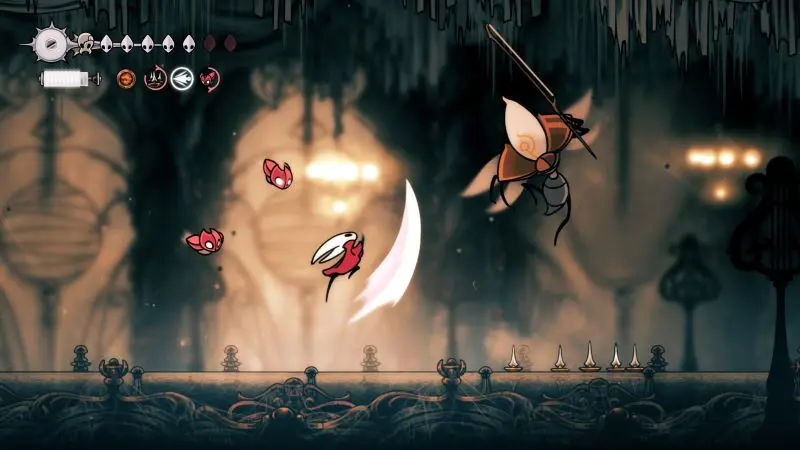
The Knight was deliberate, floaty, patient. Hornet is fast. She sprints, she dashes, she vaults, she pogos off enemies with her needle, and she heals in a fraction of the time the Knight needed — which the game compensates for by hitting far, far harder. She also talks. Her dialogue is sharp, impatient and faintly rude to almost everyone she meets, and after a whole game of a silent protagonist it completely reframes how the world feels.
The tempo change is not cosmetic. Bosses in Silksong are built around the assumption that you can reposition instantly, so their attacks cover ground the Knight would never have been expected to escape. Playing this like Hollow Knight is the single most common reason people bounce off the first few hours.
Silk: the Resource That Makes Everything Risky
Here is the mechanic the entire game hangs on. Silk is earned by attacking. Hitting enemies and striking certain objects fills your Silk spool, and Silk is what keeps you alive:
- 🪡 Bind — the heal. Hornet wraps herself in thread and restores three masks at once, and she can do it in mid-air. It is fast and generous — but it drains the entire spool in one go, whether the spool was full or nearly empty.
- ✨ Silk Skills — the arts. Special attacks unlocked by finding Weaver remnants scattered across Pharloom, paid for out of the same spool you heal from.
Read those two together and you have the tension that defines Silksong. You cannot turtle. Backing off, blocking and waiting for an opening does not refill anything — the only way to afford to heal is to keep hitting things. Every boss becomes a question of whether you are brave enough to take one more swing before you top up, and whether you dump the spool now for a partial heal or gamble on surviving long enough to fill it.
Seven Crests: Pick Who Hornet Is This Run
Crests are the deepest customisation layer, and they do far more than tweak numbers. Each of the seven changes Hornet’s attack speed, attack range and swing pattern, adds its own unique mechanic — bonus damage windows, charge attacks, regeneration without resting — and, crucially, determines how many Tool slots of each colour you get.
Swapping Crest is not respeccing a build; it is changing what kind of fighter you are. A Crest that gives you a long, slow, heavy needle plays nothing like one built around rapid short jabs, and the Tool loadout each one permits pushes you further in that direction. Most players find one they love, get stuck on a boss, and discover the answer was a completely different Crest all along.
Tools, Colour-Coded
- 🔴 Red Tools — offensive. Throwables and weapons you fire manually. They run on limited charges, refilled with Shell Shards at Benches, so they are a consumable resource you commit rather than spam.
- 🔵 Blue Tools — support. Passive and utility effects that work quietly in the background.
- 🟡 Yellow Tools — utility. The other half of the passive kit, covering exploration and survivability.
Tools are found out in the world, and the Crafting Kit lets you refine the ones you own to strengthen their effects. Between Crests and Tools, two players fifteen hours into Silksong can be playing recognisably different games.
The Movement Ladder
Like any good Metroidvania, half the map is locked behind abilities you do not have yet. Hornet’s unlock chain includes:
- 🪝 Clawline — a grappling hook that snaps her across gaps and up walls, and the ability that most changes how the map reads.
- 🧥 Drifter’s Cloak — catches the wind for a controlled, gliding descent.
- 🧗 Cling Grip — wall climbing, opening up every vertical shaft you previously had to route around.
- 🚀 Silk Soar — a vertical launch off the needle for pure height.
- 🪡 Silk rope swing and needle thrust — the acrobatic base kit that everything else builds on.
Benches remain the anchor of the loop: they heal you, they are your respawn point, and they are where you re-tune your Crest, Tools and Silk Skills. Sitting down before a boss to rebuild your entire loadout for that specific fight is not cheesing — it is how the game expects to be played.
Pharloom: Over 200 Foes and More Than 40 Bosses
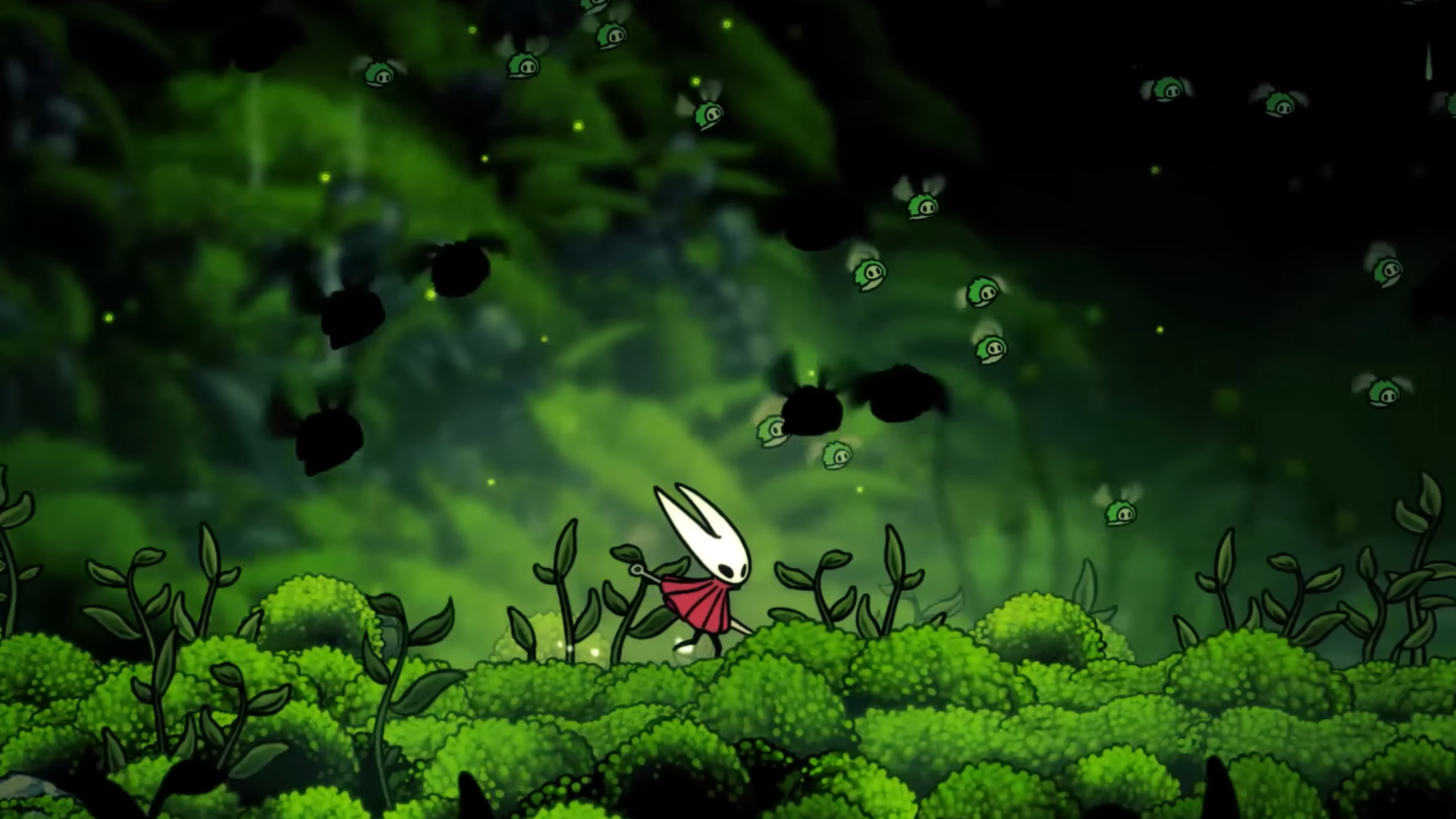
The kingdom is bigger and more varied than Hallownest, and Team Cherry’s own pitch sums it up well: coral forests, mossy grottos, gilded cities and misted moors, all stacked between you and the citadel at the top of the world. You will pass through more than ten distinct regions on the way up — from the green quiet of Moss Grotto and the small settlement of Bonebottom near the bottom, through industrial depths and drowned moorland, to the gold and marble of the Citadel itself.
Pharloom is not merely ruined, it is haunted — afflicted by a madness called the Haunting that reanimates the dead through silk. Over 200 enemy types populate it: beasts and hunters, monsters and knights. And more than 40 bosses stand between you and the summit, from fabled heroes to fallen kings, most of them multi-phase, all of them capable of ending a twenty-minute run in four seconds.
Christopher Larkin returns for the soundtrack, and it drew close to universal acclaim on release — haunted, playful, and constantly pulling you toward the next room.
Wishes: Side Quests That Are Actually the Main Quest
Silksong adds a proper quest system. Wishes are requests from NPCs or postings on quest boards, tracked in their own menu, and they do three jobs at once: they pay you, they push you back into regions you thought you were finished with, and they carry most of the game’s character writing. Pharloom feels populated in a way Hallownest never quite did, and Wishes are the reason.
They are also not optional in the way you might assume. The game runs in three acts: the first two are Hornet’s ascent toward the Citadel, and Act 3 only opens once you have completed a substantial number of Wishes and objectives. Players who sprint the critical path and ignore the world genuinely cannot reach the real ending — and there is more than one ending, with the deepest of them gated behind serious commitment.
About That Difficulty — the Honest Version
Silksong is harder than Hollow Knight, and this was the single most argued-about thing about it at launch. Enemies deal more damage. Boss runbacks — the walk from the Bench back to the fog gate — are long. Currency is scarce early. And the game asks you to pogo diagonally off enemies and hazards, a genuinely awkward skill that some players never fully make peace with.
Reviews split cleanly on it. Some critics argued the difficulty is what gives the game its character and makes mastery feel earned; others found it demoralising and said it discouraged the exploration the series is built on. Within days of launch there were mods to soften it. Steam users, with characteristic bluntness, gave it the Best Game You Suck At award. Go in expecting to lose repeatedly and it is one of the best action games ever made; go in expecting Hollow Knight’s pacing and it will hurt.
How It Was Received
Very well, difficulty debate included. Metacritic landed around 90–92 across platforms and 97% of OpenCritic reviewers recommended it. Eurogamer, NME and Nintendo Life gave it full marks; IGN, GameSpot, Game Informer and Destructoid all gave 9/10. Critics singled out the art direction — the layered, intricately detailed backgrounds — the soundtrack, the boss design, and Hornet herself as a protagonist with an actual personality.
Commercially it was enormous: over 500,000 concurrent players on Steam on day one, more than 7 million copies sold by mid-December 2025, and top of both the Steam and eShop charts. It took Best Action/Adventure Game at The Game Awards 2025, Game of the Year at the Steam Awards, and PC Game of the Year plus Best Self-Published Indie at the Golden Joysticks, alongside Game of the Year, Art Direction and Music nominations it did not convert.
Sea of Sorrow — the Free Expansion
Team Cherry announced Sea of Sorrow in December 2025: a free expansion arriving in 2026 that takes Hornet across and beneath the salt-stricken seas below Pharloom, adding new areas, new bosses, new Tools and new NPCs. Long-time watchers noticed the teaser gestures at content cut during development, which has the community fairly convinced that regions shown in old 2019 trailers are finally coming back.
Advice for Your First Few Hours
- Be aggressive. It is the healing strategy. Silk only comes from hitting things. Playing defensively starves you of the resource you need to survive, which feels deeply counterintuitive and is the fastest habit to fix.
- Bind in the air, mid-fight. Do not wait for a safe corner like you did in Hollow Knight. Hornet heals fast enough to do it inside a boss pattern, and learning which gaps allow it is most of the skill ceiling.
- Re-tune at the Bench before every hard boss. Different Crest, different Tools, different Silk Skill. Turning up with a general-purpose loadout is how a boss stays impossible for an hour.
- Save red Tool charges for phase two. They are limited and cost Shell Shards to refill — spending them on the easy opening phase is throwing damage away.
- When you are stuck, go sideways. This is a Metroidvania before it is a boss rush. A wall you cannot pass usually means there is a movement ability one region over.
- Take every Wish you are offered. They pay, they teach you the map, and Act 3 will not open without them.
- Practise the diagonal pogo deliberately. Find a harmless spike or enemy and drill it. It is the one mechanical skill the game will not let you avoid.
- Long runbacks are part of the fight. Use them. Every walk back is a free rehearsal of the boss’s opening — arrive with a plan instead of arriving annoyed.
Hornet wakes up in a cage at the bottom of a kingdom that wants her dead, holding a needle and a spool of thread. Everything from there is up.
Hot Games

New Games

