Rooftop Snipers
Games You May Like
Minimal Controls, Maximum Duel Drama
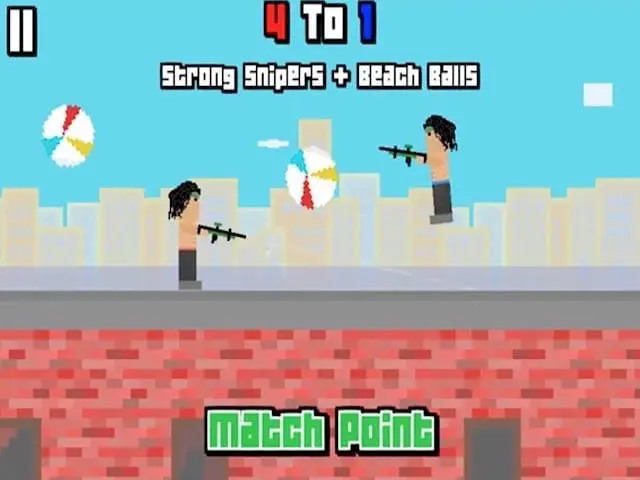
Rooftop Snipers proves that a great competitive game does not need many buttons. You jump, you shoot, and you try to blast the other player off the roof before they do the same to you. That sounds almost too small to sustain itself, yet the match design, recoil behavior, and absurd physics create exactly the kind of chaotic tension that makes quick duel games so memorable. One clean shot can end the round, but so can one badly timed jump or one recoil-heavy miss that sends you into a terrible position.
The simplicity is deceptive. The game is easy to understand in seconds, but there is a real learning curve in how you time jumps, control your spacing, and predict the recoil after firing. That is why it works equally well as a party game and as a serious head-to-head reflex test.
Why the Two-Button Format Feels So Good
Because the controls are so limited, every decision becomes legible. If you lose a round, you usually know why. You jumped too early, fired from a bad angle, drifted too close to the roof edge, or ignored the recoil that followed your own shot. That clarity keeps rematches fast and addictive because players immediately believe they can correct the last mistake.
- Jump timing: Movement is awkward by design, so jumping at the wrong moment often creates the exact vulnerability your opponent needs.
- Shot recoil: Firing changes your balance and position, meaning offense always carries a little risk.
- Edge pressure: Being near the roof boundary turns even weak hits into dangerous situations.
- Mind games: With so few actions available, predicting the opponent becomes a huge part of winning.
How Better Players Control the Chaos
Experienced Rooftop Snipers players use patience more than panic. They do not fire the instant they can. They wait for the moment when the opponent is drifting, landing, or overcommitted to a jump. They also understand when a jump should be defensive rather than aggressive. Escaping a dangerous angle is often smarter than forcing a risky midair shot with terrible recoil.
Why the Game Is So Replayable with Friends
Few duel games create laughter as reliably as Rooftop Snipers because every round can swing on something dramatic and very visible. A jump goes slightly wrong, a recoil kick sends somebody backward, a lucky-looking shot lands, and suddenly the entire match turns. Yet under all that comedy, there is still real improvement to be made, which is why repeated sessions stay fun rather than feeling like a pure coin flip.
Better Duel Habits
- Do not fire on cooldown: Wait until the shot creates positional advantage, not just noise.
- Respect recoil near edges: Some self-created risks are worse than the enemy pressure you are trying to answer.
- Force awkward landings: Opponents are most vulnerable when descending from predictable jumps.
- Stay calm after a weird round: The game is chaotic, but consistency still wins over long sets.
Hot Games

New Games

