Pool
Games You May Like
Pool: One Cue Ball, One Red Ball, and a Table Designed to Embarrass You
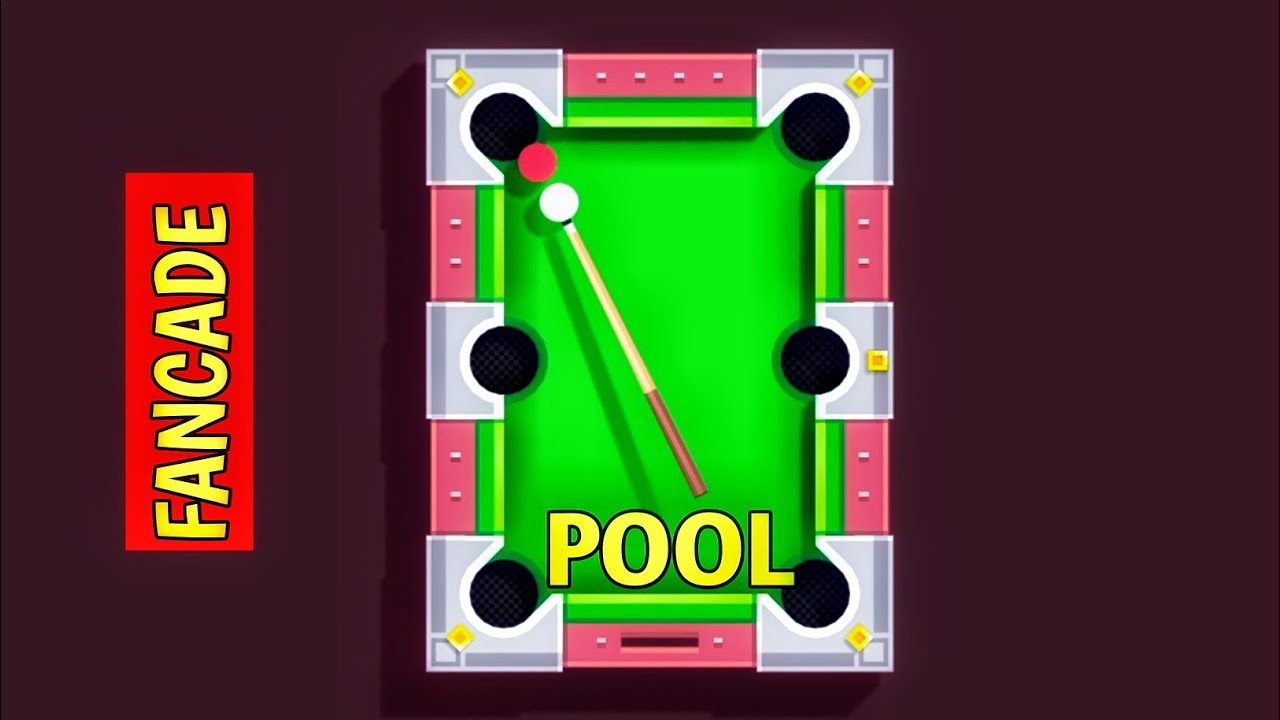
First, an expectation to set, because it changes how you approach it. Pool is not a full 8-ball simulator with racks and stripes and solids. It is something leaner and, honestly, more interesting: a puzzle box shaped like a pool table. You get a cue ball. You get one red ball. You get a pocket. And you get a table arrangement that has been deliberately set up to make the obvious shot impossible.
Your job, every single time, is to find the line. Sometimes that means a straight cut you have to judge to within a degree. Sometimes it means going nowhere near the pocket and bouncing off two rails to arrive from behind. The game does not explain which; it just presents the table and waits.
It is a recent one — Fancade released it in September 2024 — and it has already gathered 66,792 ratings at a 4.2 average. It runs on desktop, phone and tablet.
Controls
Click and drag the cue stick to aim, then release to shoot. The direction of your drag sets the line and the distance you drag sets the power. On a touchscreen it is the same gesture with a finger. There is no spin control, no english, no second button — just angle and strength, which is precisely why it is hard to blame anything but yourself.
Three Things Decide Every Shot
Every table in this game is asking you the same three questions, and getting two of them right is not enough.
- 📐 The angle. Not the angle from the cue ball to the red ball — the angle from the cue ball to the contact point that will send the red ball where you want. Beginners aim at the ball. You have to aim at the spot on the ball.
- 🗺️ The route. Many tables have no direct line at all, so the answer lives in the rails. A cushion bounces the ball at a mirrored angle, which means you can plan a two- or three-rail path if you can visualise the reflection.
- ⚡ The power. The one that actually ruins runs. Too soft and the ball dies before the pocket, or does not carry through the bank. Too hard and it rattles out of the jaws, or worse, the cue ball follows it straight in.
Power Is the Skill Nobody Practises
It is worth calling this out on its own. Most players get reasonably good at aiming within a few minutes — the geometry is intuitive once you stop targeting the centre of the ball. Power stays bad for much longer, because there is no visible number to learn, only the length of a drag.
The fix is to consciously use less power than feels right on direct shots. A ball rolling into a pocket at walking pace drops. A ball arriving at speed hits the back of the pocket and bounces out. Save the hard shots for genuine multi-rail routes where the ball needs to survive two cushions before it arrives.
Why It Feels So Clean: the Fancade Thing
If Pool feels unusually well-made for a browser game, that is because of who built it. Fancade is the studio behind a whole shelf of minimalist physics puzzlers — Drive Mad, Stacktris, Odd Bot Out, Recoil, Speed King, Longcat, Monster Tracks, Gobble and Mekorama — and every one of them follows the same recipe.
That recipe is: one mechanic, no tutorial, and levels that teach by killing you. There is no text explaining the rails or the power meter. You take a bad shot, you watch what the ball does, and you understand the physics a little better. Fancade games trust the player to work it out, and the clean, almost toy-like presentation is there so that nothing distracts from the one thing you are learning.
Recognising a Fancade game is a useful shortcut, actually — if you liked how this one taught you, their whole catalogue works the same way.
Reading a Bank Shot
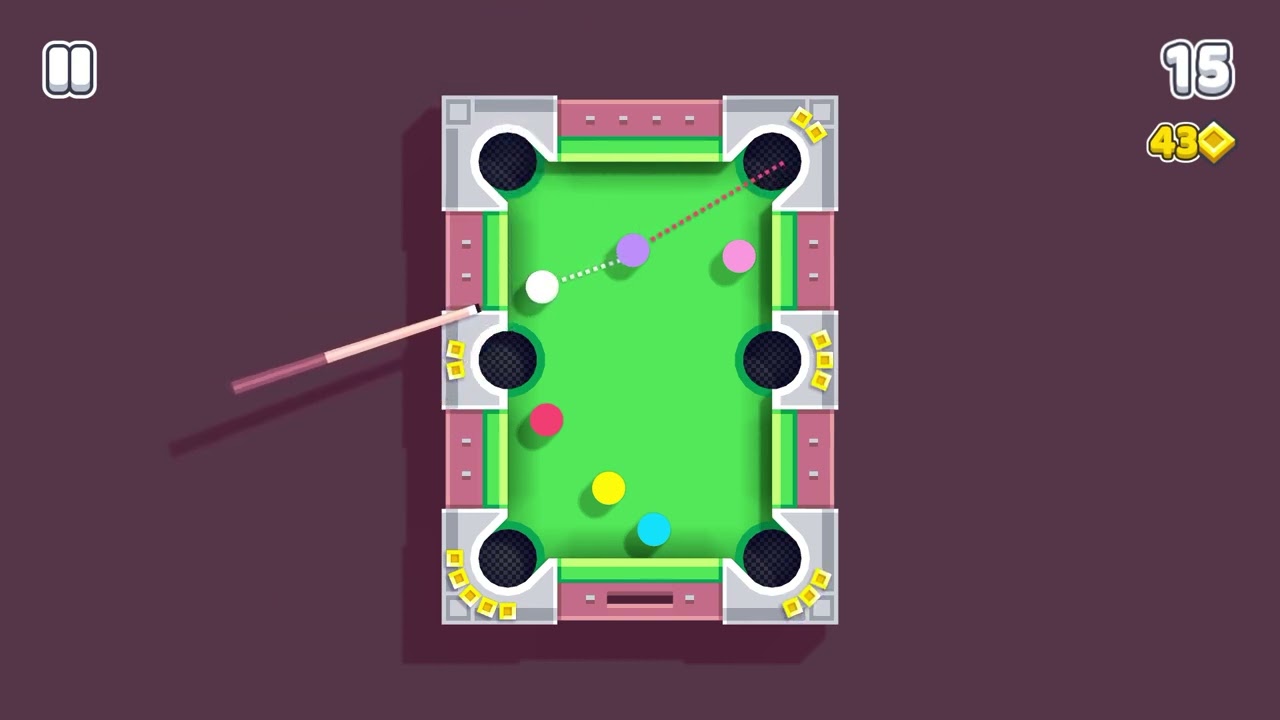
Since the rails do most of the heavy lifting on the harder tables, one piece of real billiards technique is worth knowing: a ball comes off a cushion at roughly the same angle it went in, mirrored. So to plan a bank, imagine the pocket reflected through the cushion you intend to use — an identical table flipped over on the far side of that rail — and aim straight at the imaginary pocket. Your ball will arrive at the real one.
It sounds fiddly and it becomes automatic within about ten shots. It is also the single technique that turns "there is no shot here" tables into solvable ones.
Getting Better at It
- Aim at the contact point, not the ball. Picture where on the red ball the cue ball needs to strike to push it toward the pocket, and aim your cue at that.
- Look for the rail solution first on awkward tables. If the direct line is blocked or the cut angle is brutal, the intended answer is almost always a bank.
- Default to gentle. Under-hitting costs you a shot. Over-hitting rattles the ball out of the pocket and can sink your cue ball with it.
- Watch the failed shot all the way through. Do not restart the instant you know you have missed. Where the ball ends up tells you the true angle you needed.
- Think about where the cue ball stops. On tables where a follow-through could drop the white, aim to strike thin so the cue ball loses most of its speed on contact.
- Play on desktop for the tight ones. A mouse gives finer angle control than a fingertip when a shot needs single-degree precision — though the game plays perfectly well on a phone for most tables.
If You Like This One
The drag-to-set-angle-and-power gesture is a whole little genre of its own. Bowmasters uses the exact same input for throwing weapons across a gap, so the aiming instinct transfers directly. And if you want ball-into-target precision with a timing element instead of a geometry one, Flappy Dunk is the arcade version of the same satisfaction.
No download, no account — line one up, drag back, and see whether your geometry is as good as you think it is.
Hot Games

New Games

