Flappy Dunk
Games You May Like
Flappy Dunk: Flappy Bird Went to a Basketball Court and Never Came Back
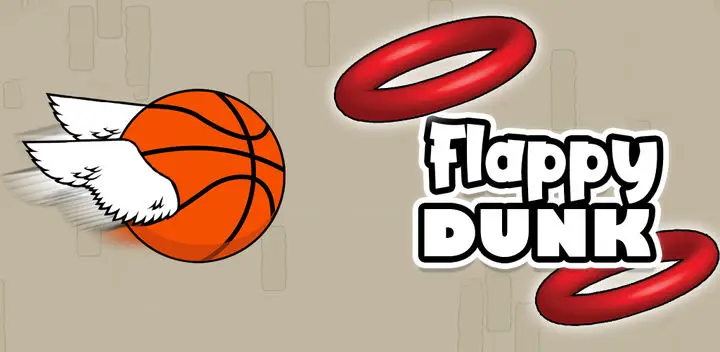
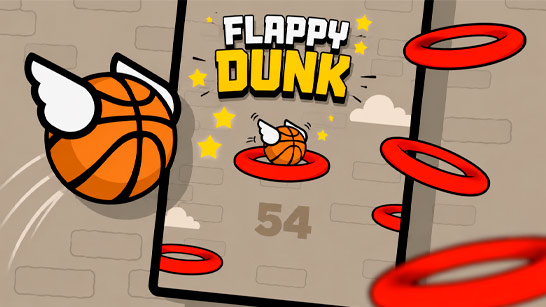
Flappy Dunk is exactly the mashup its name promises, and the moment you see it the joke lands: it is a basketball, it has little wings, and it flaps. Voodoo took the one-tap gravity loop that made Flappy Bird inescapable in 2014 and gave it something Flappy Bird never had — a target worth hitting well.
Because in Flappy Bird, a gap was pass or fail. Here, every hoop grades you. Scrape through off the rim and you survive; drop it clean through the middle and the game rewards you properly. That single change turns a survival game into a skill game, and it is why this one is still being played nearly a decade after release.
It launched on iOS in May 2017, hit Android that July and the browser that August, and has since passed 10 million downloads with a 4.2 rating from over 229,000 reviews. The browser build here is the full HTML5 version and works on desktop, phone and tablet, in portrait or landscape.
Controls
Left mouse button, or tap the screen. That is the entire control scheme. Each input gives the ball a small upward lift; gravity handles everything else. There is no aim, no power meter, no second button.
The Tap Is a Volume Knob, Not a Button
Here is the thing new players get wrong, and it is worth understanding before your first run. You are not pressing a jump button. You are managing altitude over time, and the only variable you control is how often you tap.
- 👆 Rapid taps climb steeply. Useful for a hoop high on the screen, dangerous because the ceiling is fatal.
- ⏸️ Spaced taps hold a rough altitude — this is your cruising state, and most of a good run is spent here.
- 👇 No taps is a controlled dive. Falling is not failure, it is how you line up a low hoop.
The skill is in reading the next hoop’s height and choosing your tap rhythm several ball-lengths in advance. Tap when you see the hoop and you are already too late — the ball has weight and takes a moment to change direction.
Swish: Where the Score Actually Lives
Surviving a hoop and swishing a hoop are different results. A swish is a clean pass straight through the centre without clipping the ring, and swishes are what build your score multiplier. Chain enough of them and the ball catches fire — the visual signal that your multiplier is running hot and every subsequent hoop is worth substantially more.
This is where the "one more run" hook actually lives. A broken streak does not end your game, it just resets the thing you had spent ninety seconds building. Losing a fire streak at hoop thirty stings far more than dying does, and it is the exact feeling that makes you tap restart without thinking.
Three Ways to End a Run
- ⬇️ The floor. Stop tapping for too long and gravity finishes the job.
- ⬆️ The ceiling. The one that catches Flappy Bird veterans out. Panic-tapping is a death sentence here — the top of the screen kills you exactly like the bottom does.
- 🏀 A missed hoop. Fly past one instead of through it and the run is over. You cannot skip a bad approach and try again on the next one.
That third rule is the important one. It means every single hoop is mandatory, so you can never bail out of a difficult approach — you have to commit to solving it.
Arcade and Challenge
There are two ways to play. The endless arcade run is the classic: no finish line, one number, go as far as you can. Then there is a challenge mode built out of discrete structured levels, each with its own hoop layout to solve rather than an infinite stream to survive.
They train different things. Arcade rewards consistency and nerve over long stretches; challenge levels are short enough that you can attack a specific tricky arrangement over and over until the tap rhythm is muscle memory. Bouncing between the two is the fastest way to improve.
Unlockable Balls
Points accumulate into unlocks, and the reward is a growing collection of ball skins. Purely cosmetic — nothing changes the physics, which is the right call for a game this precise — but it gives long arcade runs a second thing to be working toward when your high score is not moving.
Why This One Survived the Flappy Clone Wave
In the years after Flappy Bird, app stores drowned in one-tap gravity games, and almost all of them are gone. Flappy Dunk is still here, and the reason is structural rather than lucky.
A Flappy Bird pipe gap only ever asks a yes-or-no question: did you fit through? A basketball hoop asks a graded one: did you fit through, and how cleanly? Adding the swish and the fire multiplier on top of the original loop gives a skilled player something to keep chasing long after mere survival has become easy. It is a small design addition that quietly doubles the game’s lifespan.
Tips for a Longer Run
- Look one hoop ahead, always. Your eyes should be on the hoop after the one you are entering. The ball is slow to change direction, so your adjustments have to start early.
- Aim for the middle, not the gap. Target the exact centre of every hoop even when a sloppier line would clear it. Swishes are the whole scoring system, and the habit costs you nothing.
- Stop tapping on purpose. Beginners tap constantly and pin themselves to the ceiling. A deliberate pause is a control input, not a mistake.
- Fix your altitude between hoops, not at them. The moment you clear one hoop, immediately set the height for the next. Arriving already at the right level makes the shot trivial.
- Protect the fire streak like a life. When you are on fire, take the safest line through each hoop rather than the fastest. The multiplier is worth more than the seconds.
- Use challenge levels as a practice range. If one hoop arrangement keeps killing your arcade runs, go find something similar in a level and drill it where a failure costs you nothing.
If You Like This One
For more one-tap precision with the same "read it early or die" demand, Space Waves and Neon Challenge Legends both run the hold-and-release version of this idea. And if the sports-trick timing is what you enjoyed, Flip Master is the same "release at exactly the right instant" skill applied to trampoline backflips.
No download, no account. Tap once, get airborne, and go find out how many hoops you can put together in a row.
Hot Games

New Games

