AdVenture Capitalist
Games You May Like
AdVenture Capitalist: The Game That Eventually Plays Itself
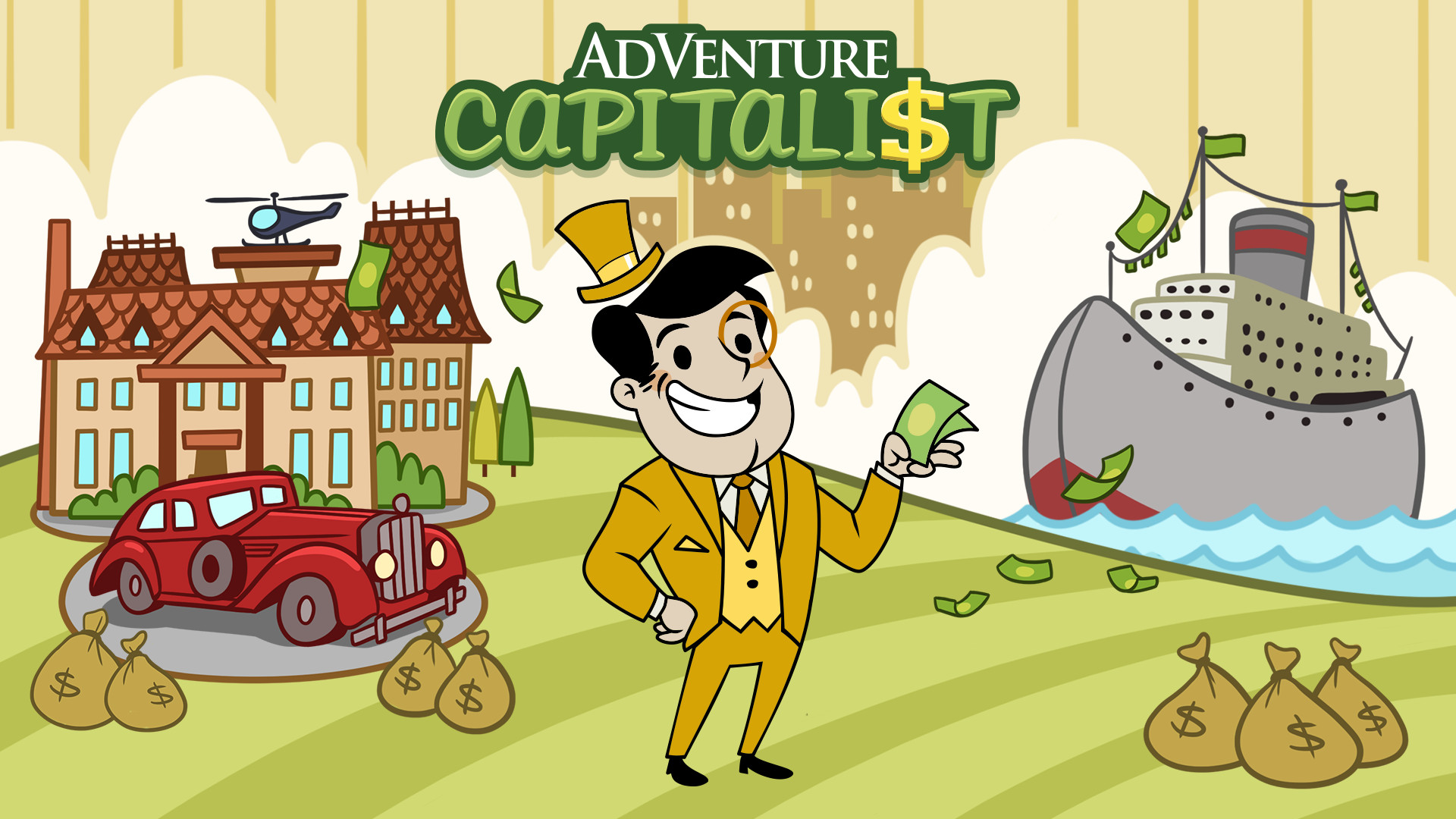
AdVenture Capitalist begins with a lemonade stand and one button. You click it, you earn four dollars, and you wait. Some hours later you own an oil company, a hockey team and a movie studio, none of which require you to be present, and you are checking the tab during meetings to see how many quadrillion dollars have accumulated since lunch.
Hyper Hippo’s idle clicker did not invent the genre, but it is the one that defined the modern shape of it, and it has aged remarkably well: over 10 million downloads and a 4.3 rating from more than 1.65 million reviews. The joke that carries it is that the game is openly, cheerfully about becoming obscenely rich for no reason at all — and it is entirely honest that the goal is just watching a number get bigger.
Controls
Click. That is it. Click a business to run one cycle of it, click Buy to own more of it, click a manager to never have to click that business again. There is no timing element, no dexterity, nothing to fail. The entire game is a series of purchasing decisions.
The Ten Businesses
Earth gives you ten ventures, unlocked in order, each dramatically more expensive and dramatically more profitable than the last:
- 🍋 Lemonade Stand — four dollars a pop. Where everybody starts and nobody stays.
- 📰 Newspaper Delivery — your first taste of a business that runs faster than you can click.
- 🚗 Car Wash
- 🍕 Pizza Delivery
- 🍩 Donut Shop
- 🦐 Shrimp Boat
- 🏒 Hockey Team
- 🎬 Movie Studio
- 🏦 Bank
- 🛢️ Oil Company — slow cycles, absurd payouts, and the thing your entire early game is secretly saving up for.
The important pattern: the later a business unlocks, the longer its cycle takes and the more it pays. A lemonade stand ticks constantly for pennies; an oil company takes an age and pays a fortune. Balancing fast-ticking small earners against slow giants is the first real strategic decision the game asks of you.
Managers: Buying Your Way Out of the Game
The single most important purchase in AdVenture Capitalist is a manager. Hire one for a business and it runs on its own, forever, with no input from you. The moment you buy your first manager, the game quietly changes genre — it stops being a clicker and becomes an idle game, and from then on your job is not to generate money but to decide where money goes.
The managers are also where a lot of the writing lives. They are named as puns and pop-culture references — the Lemonade Stand manager, Cabe Johnson, is a nod to Cave Johnson from Portal 2 — and collecting them is a small pleasure of its own.
Milestone Multipliers Are the Real Engine
Here is the mechanic new players consistently underestimate. Owning more of a business is not just linear extra income. At certain milestone counts — 25, 50, 100 and onward — that business unlocks a permanent bonus, typically doubling its profit or halving its cycle time.
This means buying the 24th lemonade stand is boring and buying the 25th is transformative. Whenever your income feels stuck, the answer is almost never "save for the next business" — it is "which milestone am I closest to?" Pushing one business over a threshold routinely doubles your entire economy in a single purchase.
Angel Investors: The Part Where You Delete Everything on Purpose
This is the mechanic that makes AdVenture Capitalist a real game rather than a waiting simulator, and it is deeply counterintuitive the first time you meet it.
At any point you can reset your entire empire. Every business, every manager, every upgrade, all of it gone, back to a single lemonade stand. In exchange, you receive Angel Investors, awarded based on how much you earned in that run, and every Angel permanently increases the profits of everything you will ever own.
So the loop is not "build an empire". The loop is:
- 📈 Build until your growth visibly slows down.
- 👼 Cash out your progress for Angels.
- 🔄 Rebuild — and blow past your previous ceiling in a fraction of the time.
The first reset feels like vandalism. The second one feels like the whole point. Players who refuse to reset are the ones who stall out at a few million and conclude the game is slow; players who reset aggressively are the ones reaching numbers with names they have never heard before.
Angels can also be spent on Angel upgrades that multiply their effect further — so there is a second layer of decision about whether to hoard them for the passive bonus or invest them.

Then You Leave the Planet
Earth is not the end of it. AdVentures unlock on the Moon and Mars, and these are not reskins — each has its own businesses, its own upgrades, its own managers and its own separate economy to build from scratch. Discovering that the game has two more full campaigns hidden behind the one you thought was the whole thing is a genuinely good moment.
It Earns While the Tab Is Closed
Everything keeps running when you are not there. Come back after a night’s sleep and there is a pile of accumulated cash waiting, which is the defining pleasure of the genre: the game respects that you have a life, and quietly rewards you for having had one. It is, as the developers put it, impossible to lose.
Events, Outfits and the Shop
Beyond the main campaign there is a rotating calendar of Limited Time Events — with names like Cashella, Profitabowl, A Capitalist Carol, Merry Merger and 1% Land — each with its own leaderboard and exclusive managers to collect. You can also dress your Capitalist in outfits and accessories that are not purely cosmetic: they carry business bonuses. The in-game shop sells Gold, Time Warps and specific managers for players who want to skip ahead.
Why This Genre Works On Us
Worth saying plainly, because it is the honest appeal: idle games work because they convert time into visible progress with no risk attached. There is no skill gate, no death, no wasted session. Every time you open AdVenture Capitalist something good has happened, and the numbers are large enough that each new order of magnitude feels like an event. It is a very well-tuned Skinner box and it does not pretend otherwise — the game’s entire sense of humour is built on being upfront about that.
How to Actually Get Rich
- Buy managers before anything else. An automated cheap business earns more over an hour than a manually clicked expensive one. Manager first, always.
- Chase milestones, not new businesses. Check which business is closest to 25, 50 or 100 and push it over. A doubled multiplier beats unlocking something new nearly every time.
- Reset earlier than feels comfortable. The right moment is when your growth has slowed, not when you are "finished". Most players wait far too long for their first Angel cash-out.
- Do not reset for a handful of Angels. The flip side: if the reset would only net a few, keep building. You are looking for a meaningful jump, not a habit.
- Let the slow giants breathe. The Oil Company and other late businesses have long cycles, so their value only shows over time. Judge them per hour, not per click.
- Come back at natural breaks. The game is designed around you closing it. Check in morning and evening rather than watching timers — the offline earnings do the work.
- Spend Angels on upgrades once you have plenty. Hoarding gives a flat passive bonus, but Angel upgrades compound. Once your reset yield is healthy, start investing them.
If You Like This One
If the "fail, cash out, come back stronger" loop is what hooked you, Into Space 2 runs the same psychology with rockets and a much shorter cycle. And if you want number-optimising with actual decisions to agonise over, Get Yoked turns the same instinct into a roguelike deckbuilder.
Nothing to install and nothing to lose — open it, sell some lemonade, and check back tomorrow.
Hot Games

New Games

