Clustertruck
Games You May Like
Clustertruck: The Ground Is Lava and Every Platform Is Doing 70mph
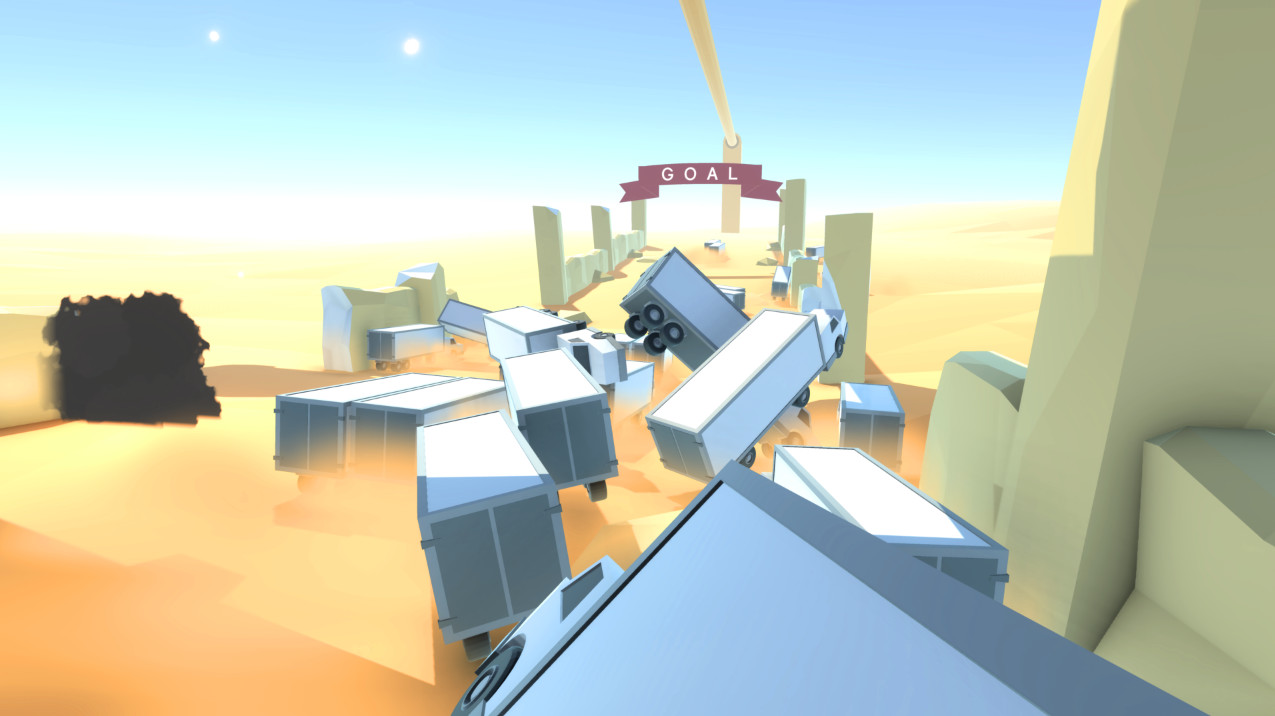
Clustertruck has one rule, and it is brutally simple: do not touch anything that is not a truck. Not the road, not a wall, not an obstacle. You are in first person, standing on the roof of a semi that is hurtling down a highway inside a convoy of other semis, and the finish line is somewhere up ahead. Everything between you and it is moving.
Landfall Games built it and tinyBuild published it in September 2016, and it remains one of the purest ideas in action platforming — a game whose entire concept fits in a sentence and whose skill ceiling somehow does not.
It Started in a Traffic Jam
The origin story is worth knowing because it explains the whole design. Landfall founder Wilhelm Nylund was travelling home from Gamescom in 2015, stuck in traffic, and idly imagined escaping the queue by jumping across the roofs of the trucks to get home faster. That is it. That is the entire pitch, and the team spent a year in Unity building nothing but that thought.
Controls
- ⌨️ WASD — move. Space to jump. Mouse to look.
- ⚡ Sprint — momentum is your main resource; a standing jump gets you almost nowhere.
- ⏳ Slow-motion — available from early on, and the single most useful thing you own.
- 🔄 Restart — instant, because you will be using it constantly.
Why It Is Harder Than It Looks: Nothing Here Is Scripted
This is the thing that makes Clustertruck genuinely different from other precision platformers, and it is worth understanding before you get frustrated.
In most hard platformers, the level is fixed. You die, you learn the pattern, you execute it. That is the contract. Clustertruck breaks that contract entirely. The trucks are not animated along a path — they are physics objects driving themselves, and they collide, jackknife, flip, pile up and go flying. A truck that gave you a clean platform last attempt might have been rear-ended and launched into the air this time.
So you cannot memorise a route. You can only learn to read a situation quickly and improvise a line through it. That is why the game rewards a completely different skill from a level-based platformer — and why the same level can feel easy on one run and impossible on the next.
Style Points: The Game Pays You for Showing Off
Just surviving is not the only scoring axis. You earn style points for playing dangerously — chiefly for staying airborne and for skipping trucks rather than hopping along every roof in sequence.
This is a clever bit of design because it pushes you against your own survival instinct. The safe play is short hops from truck to truck; the profitable play is long, committed, terrifying jumps that clear four vehicles at once. And since style points are the currency that buys your abilities, playing scared makes the game harder later.
The Abilities Are Where It Gets Silly
Points get spent on upgrades, and they fall into two families that stack in absurd ways.
🏃 Movement abilities — what your body can do
- Double jump — the one most players call essential. Buy it early.
- Grappling hook — turns a missed landing into a recovery, and opens routes the level never intended.
- Jetpack — sustained air, which in a game where the ground kills you is close to cheating.
- Air dash — a mid-flight correction for jumps you have judged slightly wrong.
- Speed boost and levitation — for pure distance and for hanging in place while the convoy sorts itself out.
⏱️ World abilities — what you can do to the level
- Slow motion — the workhorse. Buys you thinking time inside a pile-up.
- Freeze trucks — stops the convoy dead so you can walk a route calmly.
- Spawn a truck — conjure a platform when there genuinely is not one.
- Epic mode — exactly as restrained as it sounds.
- SUPERTRUCK — the best one. Time only advances when you move, borrowing the SUPERHOT gimmick wholesale. The entire highway freezes mid-explosion while you stand still and plan, then lurches forward the instant you step.
Nine Worlds, Ninety Levels, and a Boss
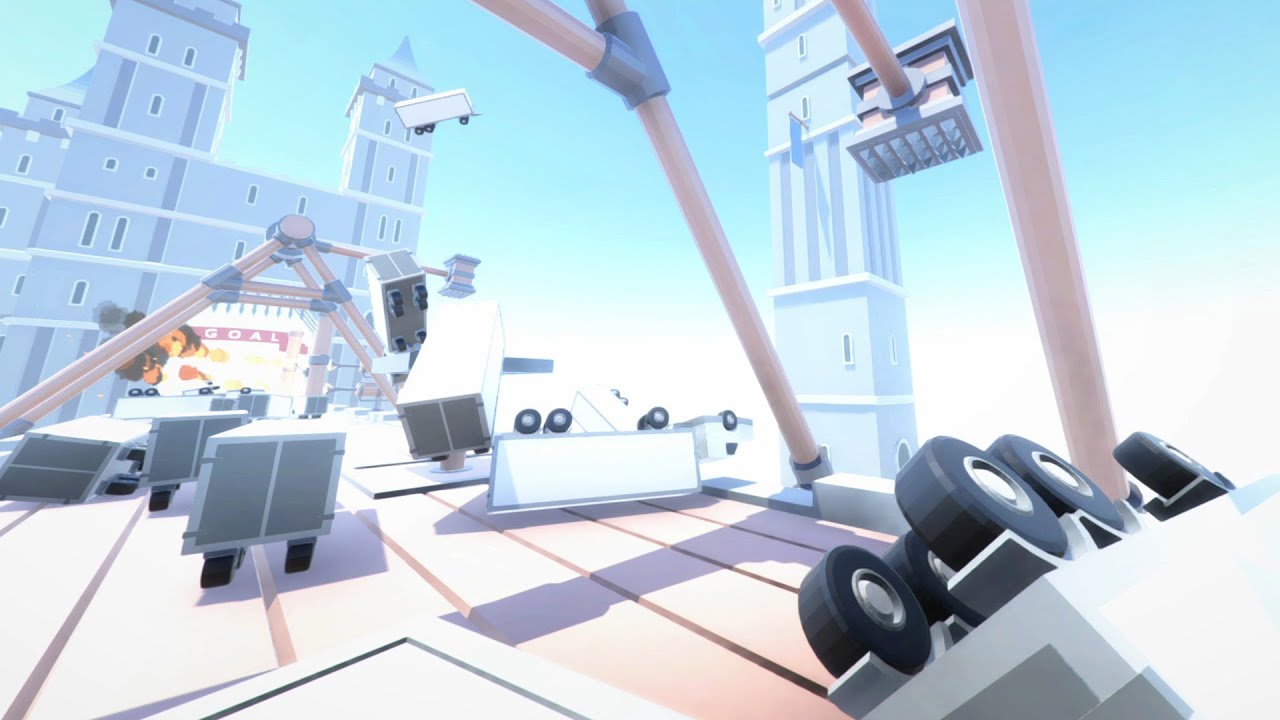
The campaign runs nine worlds of ten levels each, finishing with a boss fight. Every world introduces one new way to ruin your day rather than simply getting tighter:
- 🧊 World 3 — ice. The truck roofs become slippery, so landing a jump no longer means keeping the landing.
- 🔴 World 4 — lasers. Now the air is dangerous too, and the safest-looking gap is often the fatal one.
- 🪨 World 6 — the boulder. A chasing hazard that removes the option of waiting for a good moment. You have to keep moving forward whether the convoy is ready or not.
Later worlds keep stacking these ideas, and by the final stretch you are managing slippery roofs, aerial hazards and a convoy that is actively disintegrating around you.
The Level Editor
Clustertruck ships with a full level editor, and on the desktop release it hooks into Steam Workshop so players can publish courses and play each other’s. Given that the game’s physics produce chaos on their own, community levels tend toward the gleefully unreasonable — which is exactly the right instinct for this game.
How to Survive Longer
- Buy the double jump first. Almost every player converges on this. It converts a mistimed leap from a death into a small correction.
- Jump early, not late. Trucks move out from under you while you are winding up. Committing a fraction before it feels right is nearly always correct.
- Aim at where the truck will be. You are not jumping to a platform, you are jumping to a prediction. Lead your landing the way you would lead a moving target.
- Use slow motion in the pile-up, not before it. Save it for the moment the convoy actually breaks apart — that is when you need thinking time, not on the clean opening straight.
- Take the greedy jumps early in a level. Style points fund your abilities, and a failed showboat at second five costs you almost nothing. Play safe near the finish line instead.
- Look where you are going, not at your feet. First-person plus fast platforms punishes players who watch their landing. Keep the camera downrange and trust the jump.
- Do not wait for a perfect setup. The convoy never gets tidier — it only gets more wrecked. The clean moment is usually right now.
If You Like This One
For precision platforming that goes the exact opposite way — fixed levels you can memorise, where mastery means perfecting one known line — try OvO Dimensions. And if you want the same read-it-fast-or-die reflex test with no platforming at all, Death Run 3D throws obstacles at you in first person at similar speed.
Get on a truck, stay off the road, and try to make it look good on the way.
Hot Games

New Games

